To calculate macros for weight loss, you need four numbers: your BMR (baseline metabolism), your TDEE (total daily calorie burn), your target deficit, and then the protein, fat, and carb gram targets that fit inside it. This guide walks through each step with real examples so you finish with actual numbers — not just theory.
The shift from "eating less" to tracking macros is bigger than it sounds. Once you know your numbers, you stop guessing and start making decisions that compound. That's why macro tracking consistently outperforms vague calorie restriction for body composition — you're managing what your calories are made of, not just how many there are.
Why tracking macros beats just counting calories
100 calories from a chicken breast and 100 calories from a cookie are identical on a calorie counter. They're completely different inside your body. The chicken triggers muscle protein synthesis and keeps you full for hours. The cookie spikes blood sugar, drops it fast, and you're hungry again in 45 minutes.
That's the whole argument for macro tracking. Plain calorie counting treats all food as equivalent. Macro tracking doesn't.
What each macronutrient actually does
Before the math, it helps to understand what you're calculating and why each number matters.
- Protein — builds and repairs tissue, preserves muscle mass during a deficit (critical — losing muscle slows your metabolism), and is the most satiating macro per calorie. Getting protein right is the single most important lever in a fat loss plan.
- Fats — needed for hormone production, brain function, and absorbing fat-soluble vitamins (A, D, E, K). Cut fats too low and your mood, energy, and hormones all suffer. This is why ultra-low-fat diets tend to fail.
- Carbohydrates — your body's preferred fuel, especially for exercise. The type matters: complex carbs from whole foods provide steady energy; simple sugars cause spikes and crashes. Don't eliminate carbs — just be selective.
A macro-based plan isn't about restriction. It's about making deliberate choices so the weight you lose is fat, not muscle.
The four-phase roadmap
Here's how the full process works before diving into the numbers.
| Phase | What you do | Goal |
|---|---|---|
| Phase 1: Estimation | Calculate BMR and TDEE | Find your personal maintenance calorie level |
| Phase 2: Deficit | Set a calorie deficit (15–25% below TDEE) | Create a calorie target that drives fat loss |
| Phase 3: Allocation | Convert calories into macro grams | Define daily protein, fat, and carb targets |
| Phase 4: Adjustment | Track progress, recalibrate every 10–15 lbs | Keep the plan working as your body changes |
Step 1 — Find your personal calorie starting point

Everything starts with your TDEE — the total calories your body burns in a day across all activity. To get it, you first calculate your BMR (Basal Metabolic Rate), which is just how many calories you burn at rest if you did nothing but lie in bed all day.
The most accurate formula for BMR is the Mifflin-St Jeor equation, which is what most registered dietitians and sports nutritionists use. You can also skip the manual math with Kitchendary's free TDEE calculator.
Calculating your BMR (Mifflin-St Jeor formula)
You need four inputs: weight in kg, height in cm, age in years, and your sex. The formula adds a constant at the end (+5 for men, −161 for women).
BMR = (10 × weight kg) + (6.25 × height cm) − (5 × age) + sex constant
Example — Emma, 35 years old, 70 kg, 165 cm:
- 10 × 70 = 700
- 6.25 × 165 = 1031.25
- 5 × 35 = 175
- Female constant = −161
- BMR = 700 + 1031.25 − 175 − 161 = 1,395 calories
That's the floor — what she'd burn doing absolutely nothing. Real life burns more.
Converting BMR to TDEE with an activity multiplier
Multiply your BMR by the activity factor that most accurately describes your typical week — not your aspirational week.
| Activity level | Multiplier | Sample TDEE (Emma's BMR: 1,395) |
|---|---|---|
| Sedentary (desk job, minimal movement) | 1.2 | 1,674 calories |
| Lightly active (walking, 1–2 workouts/week) | 1.375 | 1,919 calories |
| Moderately active (gym 3× week) | 1.55 | 2,162 calories |
| Very active (physical job or daily intense training) | 1.725 | 2,406 calories |
Emma works remotely but walks 8,000 steps daily. She picks 1.375, giving her a TDEE of 1,919 calories. That's her maintenance number — the calories she needs to stay at her current weight.
If you're unsure which multiplier fits, pick the lower option. It's easier to add calories back than to undo weeks of tracking where you overcounted your burn.
Real-world calibration tips
- Log your food for 7 days at your estimated TDEE and watch what happens to your weight.
- If weight stays flat, that number is your true maintenance. If you gain, adjust the multiplier down by 0.05.
- Some people have genuinely different weekday vs. weekend activity levels — consider averaging rather than picking just one.
Kitchendary builds weekly meal menus around your TDEE automatically — enter your numbers once and it handles the rest. Start your free plan here.
Step 2 — Set a sustainable calorie deficit
Now that you have your TDEE, weight loss becomes straightforward: eat less than that number and your body burns stored fat to cover the gap. The question is how much less.
The mistake most people make is going too aggressive. Slashing 500–700 calories immediately feels manageable for a week, then becomes miserable, then gets abandoned. A smaller deficit sustained for months beats a big one that lasts three weeks.
Choosing your deficit percentage
A deficit of 15–25% below your TDEE covers the range from conservative to aggressive. Here's what each means in practice:
- 15% deficit — ideal if you're active, close to your goal weight, or want to minimize muscle loss. Slow progress but very sustainable.
- 20% deficit — the standard starting point for most people. Noticeable progress without feeling deprived. Start here if you're unsure.
- 25% deficit — suitable if you have significantly more to lose. Requires more attention to hunger signals and energy levels.
The best deficit is the one you can actually stick with. Consistency over months will always outperform perfection over two weeks.
What this looks like with real numbers
Sarah — 40-year-old professional, TDEE 2,200 calories
At a 30% deficit she'd eat 1,540 calories. That's below the threshold where performance drops and hunger becomes constant. At a 20% deficit she's at 1,760 calories — enough fuel to work, train, and not feel wretched.
Ben — 22-year-old, TDEE 2,800 calories
A 25% deficit puts him at 2,100 calories — still a substantial amount of food that supports his active lifestyle while consistently burning fat.
Research backs this approach. A major meta-analysis confirmed that the calorie deficit is the primary driver of fat loss regardless of diet type — but only when people actually adhere to it. You can read the full study on diet adherence and calorie deficits if you want the data.
Step 3 — Convert your calorie target into daily macros
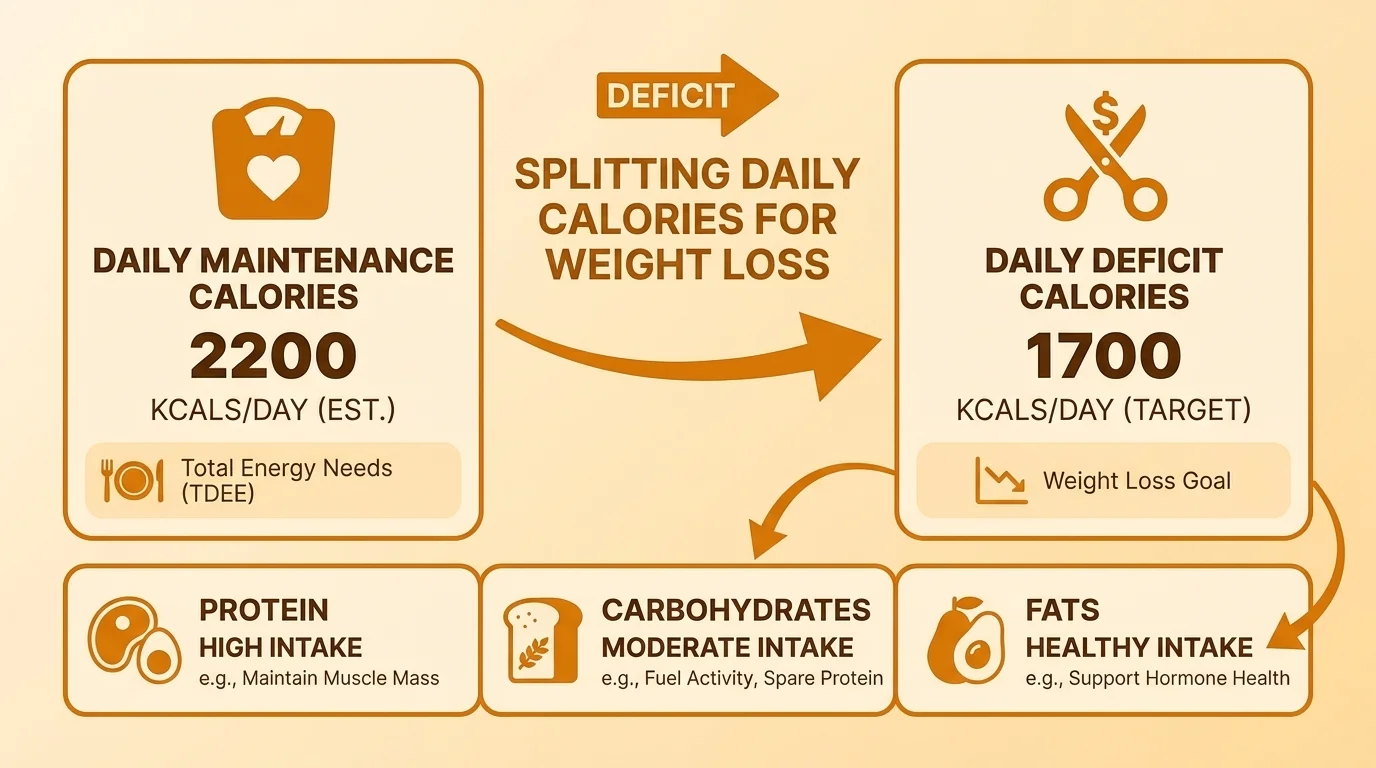
With a calorie goal in hand, you now break it into three buckets: protein, fat, and carbs. Each macro has a calorie value per gram — protein and carbs have 4 calories per gram, fat has 9 calories per gram.
The sequence matters. Set protein first (it's the most important), then fat, then fill the rest with carbs.
1. Calculate your protein target
Protein is the cornerstone of fat loss. High protein intake preserves muscle mass during a deficit, keeps hunger lower, and has the highest thermic effect — meaning your body burns more calories digesting it than it does digesting fat or carbs.
The goal is to lose fat, not just "weight." Preserving muscle is what keeps your metabolism from slowing down as the scale drops.
Target 1.6 to 2.2 grams of protein per kilogram of bodyweight (roughly 0.7–1.0 g per lb). If you're very active or at the higher end of a deficit, go toward 2.2 g/kg.
At 70 kg bodyweight: 70 × 1.6 = 112 g minimum, 70 × 2.2 = 154 g maximum. Pick a number in that range and stick to it.
To convert grams to calories: 130 g protein × 4 = 520 calories from protein.
2. Set your fat target
Fats support hormone production, brain function, and absorption of fat-soluble vitamins. Don't go below 20% of total calories from fat — that's where hormonal disruption and mood issues tend to show up.
A workable range is 20–30% of daily calories. For a 1,760-calorie target at 25% fat:
- 1,760 × 0.25 = 440 calories from fat
- 440 ÷ 9 = ~49 grams of fat per day
Good fat sources: avocado, olive oil, nuts, seeds, fatty fish. Avoid trans fats from processed and fried foods.
3. Fill the remainder with carbs
Whatever calories are left after protein and fat are allocated to carbs. Carbs power your workouts and keep your brain functioning — cutting them too low tanks performance and mood.
Example for a 1,760-calorie target, 130 g protein (520 cal), 49 g fat (441 cal):
- Remaining calories: 1,760 − 520 − 441 = 799 calories
- 799 ÷ 4 = ~200 grams of carbs per day
You can also use Kitchendary's macro calculator to run this automatically based on your specific goals.
Sample macro splits for a 2,000-calorie target
Same calorie goal, three different approaches. There's no single correct split — choose the one that fits how you eat and how active you are.
| Diet approach | Protein (g) | Fat (g) | Carbs (g) | Best for |
|---|---|---|---|---|
| Balanced | 150 | 56 | 225 | Most beginners, flexible eaters |
| Lower-carb | 150 | 78 | 150 | People who manage hunger better with more fat |
| Higher-protein | 200 | 56 | 150 | Active people prioritizing muscle retention |
Start with balanced unless you have a strong reason not to. You can always dial up protein or reduce carbs once you see how the initial split feels after two to three weeks.
A sample day on 1,760 calories and balanced macros
Abstract numbers are easier to follow when you can see what they look like on a plate. Here's what a 1,760-calorie day might look like at roughly 40% protein, 25% fat, 35% carbs (175 g protein, 49 g fat, 154 g carbs).
| Meal | Food | Protein (g) | Fat (g) | Carbs (g) | Calories |
|---|---|---|---|---|---|
| Breakfast | 3 scrambled eggs + 1 slice whole-grain toast + coffee | 22 | 14 | 18 | 290 |
| Lunch | Grilled chicken breast (150 g) + brown rice (100 g cooked) + side salad | 45 | 6 | 42 | 410 |
| Snack | Greek yogurt (200 g, 0% fat) + 1 banana | 20 | 1 | 38 | 240 |
| Dinner | Salmon fillet (150 g) + roasted vegetables + sweet potato (150 g) | 40 | 18 | 38 | 470 |
| Evening | Cottage cheese (150 g) + handful of almonds (20 g) | 22 | 10 | 7 | 210 |
| Total | 149 | 49 | 143 | 1,620 |
That's a 140-calorie buffer left for cooking oils, condiments, or a small evening snack. Real meal planning always needs that buffer — you're not eating in a lab.
If building this kind of plan manually every week sounds tedious, Kitchendary does it in about 60 seconds. You enter your targets, it generates a full seven-day plan with a grocery list included.
Focusing on food quality, not just gram targets
150 grams of carbs from steel-cut oats and 150 grams of carbs from chips hit the same number in your tracker. They do not hit the same spot in your body. One gives you steady energy, fiber, and micronutrients. The other spikes blood sugar, drops it fast, and leaves you hungry within the hour.
This matters practically, not just nutritionally. Whole foods make your deficit easier to stick to because they keep you fuller longer. Processed food makes you feel deprived even when you're technically "on track."
Simple food swaps that improve your macros
| Instead of | Try this | Why it's better |
|---|---|---|
| White rice | Quinoa or brown rice | More fiber, slower energy release, keeps you fuller |
| Sugary cereal | Oatmeal with berries | Sustained fuel, more protein, antioxidants |
| Creamy dressings | Olive oil and vinegar | Clean fats, no added sugars or emulsifiers |
| Processed deli meats | Grilled chicken or canned tuna | Higher protein per calorie, much less sodium |
| Flavored yogurt | Plain Greek yogurt + fruit | More protein, less sugar, same satisfaction |
A 20-year U.S. study published in JAMA Network Open found that diets low in refined carbs but rich in plant-based proteins and healthy fats led to significantly less weight gain over time compared to diets heavy on processed foods. You can read the full study on macro quality and long-term weight outcomes.
Knowing how to calculate macros for weight loss is the foundation. What you fill those macros with determines whether the plan is sustainable. For practical high-protein meal ideas that work within a deficit, explore high-protein meal prep ideas that make hitting your targets easier week to week.
How to adjust your macros as you progress
Your starting macro numbers are a baseline, not a permanent prescription. As you lose weight, your TDEE drops — a smaller body burns fewer calories. If you ignore this, what was once a 20% deficit becomes a 10% deficit, and progress stalls.
Track more than just the scale. Weight fluctuates day to day due to water, sodium, and digestion. Better signals of real progress:
- Body measurements — waist, hips, chest, and thigh circumference tracked every two weeks. You can lose inches while the scale barely moves (fat loss + muscle gain happening simultaneously).
- Progress photos — front, side, and back, same lighting, same time of day, monthly. Photos reveal body composition changes that weight never shows.
- Gym performance — are you getting stronger or at least maintaining? If lifts are dropping sharply, you may be losing muscle, which means protein intake needs to go up.
- Energy and hunger — constantly exhausted or ravenous? That's a signal your deficit is too aggressive or your food quality is too poor.
When and how to adjust
If weight and measurements haven't changed in two to three weeks and you've been consistent, it's time to adjust. Don't cut 300 calories at once. Cut 50–100, usually from carbs or fat, and watch for two more weeks.
Recalculate your full TDEE and macros after every 10–15 pounds of weight loss. That's the threshold where the numbers drift enough to matter.
Common pitfalls to avoid
- Fat too low (below 20% of calories) — hormone disruption, mood crashes, persistent fatigue. Keep fats at a minimum of 20%.
- Liquid calories untracked — creamer, juice, alcohol. A glass of wine is 125–150 calories. A latte with whole milk is 200. It adds up faster than you'd expect.
- Eyeballing instead of measuring — cooking oils and nut butter are the worst offenders. One tablespoon of olive oil is ~120 calories; poured loosely into a pan it's easy to use three without realizing it.
- Carbs too low without a plan — unless you're deliberately doing keto, cutting carbs below 100 g/day typically tanks gym performance and makes the diet harder to sustain.
If you want to stop managing these adjustments manually, Kitchendary's AI meal planner updates your weekly plan automatically as your targets change — new meals, new portions, same goals.
FAQ
Do I have to hit my macros perfectly every single day?
No. Chasing daily perfection leads to frustration fast. Aim to land within 5–10 grams of your protein and carb goals, and within 2–5 grams of your fat target. Your weekly average is what drives results, not any one day.
What happens if I go over my calories for a day?
Nothing catastrophic. One day over target won't undo weeks of work. Skip the urge to restrict heavily the next day — that cycle of binging and restricting is harder to recover from than a single big meal. Just return to your normal plan at the next meal.
How often should I recalculate my macros?
After every 10–15 pounds of weight loss is a good rule of thumb. As your body gets smaller, your TDEE drops — so your original calorie target may stop being a true deficit. A quick recalculation keeps your plan effective.
What is the best macro ratio for weight loss?
There is no single best split, but a common starting point is 30% protein, 25% fat, and 45% carbs. Higher-protein splits (35–40% protein) tend to preserve more muscle and control hunger better during a deficit. Adjust based on how you feel and perform.
Can I use an app to calculate my macros automatically?
Yes — and it saves a lot of time. Kitchendary's AI meal planner takes your TDEE, calorie deficit goal, and dietary preferences, then generates a full weekly plan with meals already hitting your macro targets. You skip the spreadsheet math entirely.