The fastest way to start meal planning: pick one clear goal, find your daily calorie target with a TDEE calculator, then build your meals using the Plate Method — half the plate vegetables, a quarter protein, a quarter complex carbs. That's the whole system in one sentence.
Everything below is just how to make that system work in real life, with real schedules and real grocery budgets. No five-star recipes. No complicated macro spreadsheets. Just a framework you can actually repeat week after week.
Start with one honest goal
Before you look at a single recipe, you need to know what you're actually trying to do. Weight loss, muscle gain, and general healthy eating each require a different calorie setup, and trying to optimize for all three at once is how most beginners get confused and give up.
Pick one. Be specific. "I want to eat healthier" is too vague to act on. "I want to cook dinner at home four nights a week" is something you can actually measure.
A 2023 Gallup poll found that only 75% of people globally rated their diet as "mostly healthy" — down from 82% the year before. In the US, the number dropped from 83% to 71%. Most people want to eat better. The ones who actually do it tend to have a concrete target, not a vague intention.
How do I figure out my daily calorie needs?
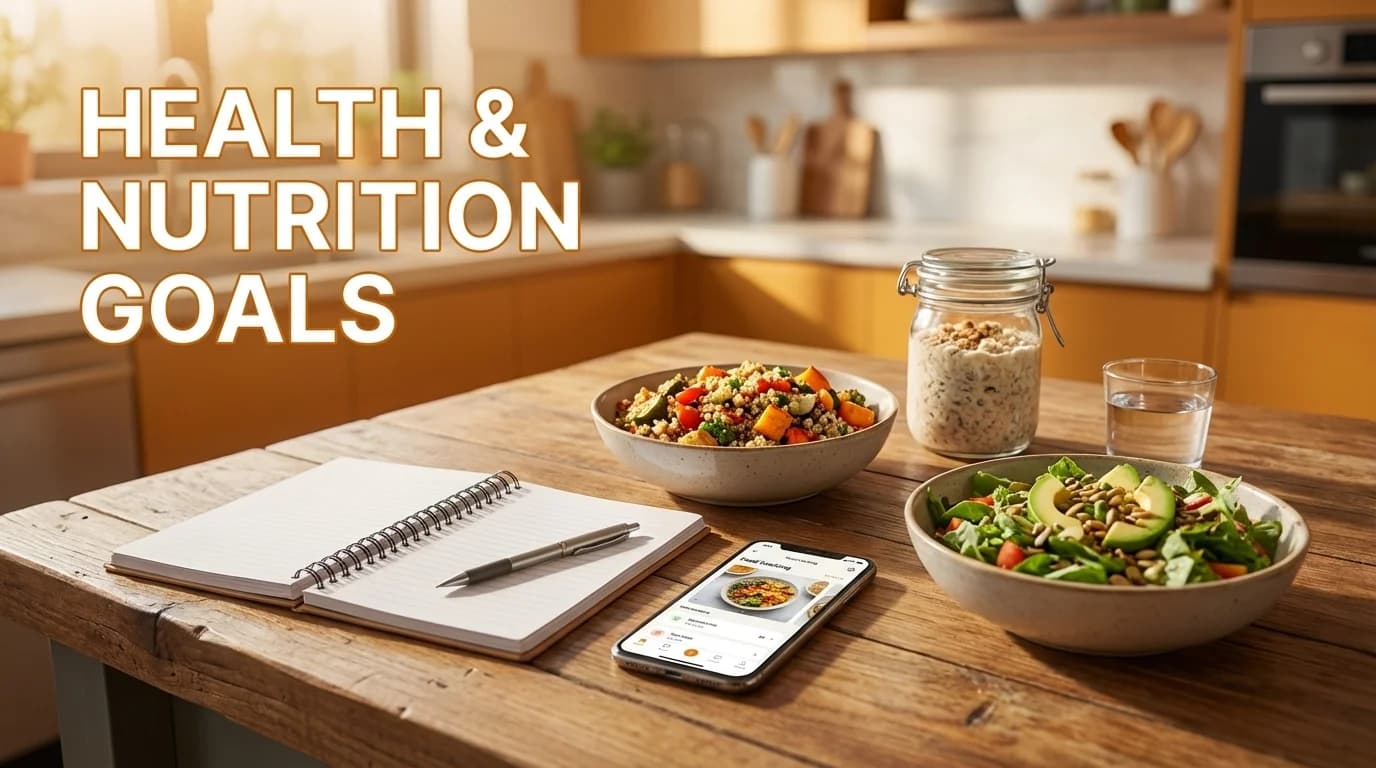
Your Total Daily Energy Expenditure (TDEE) is the number of calories your body burns in a full day — exercise included. It's your starting number for any meal plan.
You don't need to calculate this by hand. A TDEE calculator takes your age, weight, height, and activity level and gives you a solid estimate in about 30 seconds. Once you have that number, translating it into a daily calorie target is straightforward:
| Goal | Daily adjustment | Example (2,000 cal TDEE) |
|---|---|---|
| Weight loss | 250–500 calorie deficit | 1,500–1,750 calories |
| Muscle gain | 250–500 calorie surplus | 2,250–2,500 calories |
| Maintenance | Eat at TDEE | 2,000 calories |
These are starting points, not permanent numbers. Your TDEE shifts as your weight, muscle, or activity level changes — recalculate every few months or after any major lifestyle change.
If you want to go deeper on calories and macros at the same time, the calorie and macro calculator breaks down your protein, fat, and carb targets alongside your daily calorie goal.
Be honest about your actual constraints
Here's where most people trip up. They find a "perfect" plan online that calls for an hour of cooking on nights when they have 20 minutes. The plan collapses by Wednesday.
Before you pick a single recipe, answer these four questions:
- How much time can you realistically spend cooking on weeknights — 20 minutes? 45?
- Do you follow any specific diet (vegan, keto, gluten-free)?
- Do you have any food allergies or intolerances?
- What's your weekly grocery budget?
A plan built around your real life will outlast a "perfect" plan that ignores it every time. Tools like Kitchendary let you set all of these constraints upfront so the plan it generates actually fits your schedule.
How do I build a weekly meal plan?
You've got your calorie target. Now you need actual meals. The goal here isn't finding impressive recipes — it's building a simple, repeatable structure you can execute on a Tuesday after a long day.
Use the Plate Method as your anchor
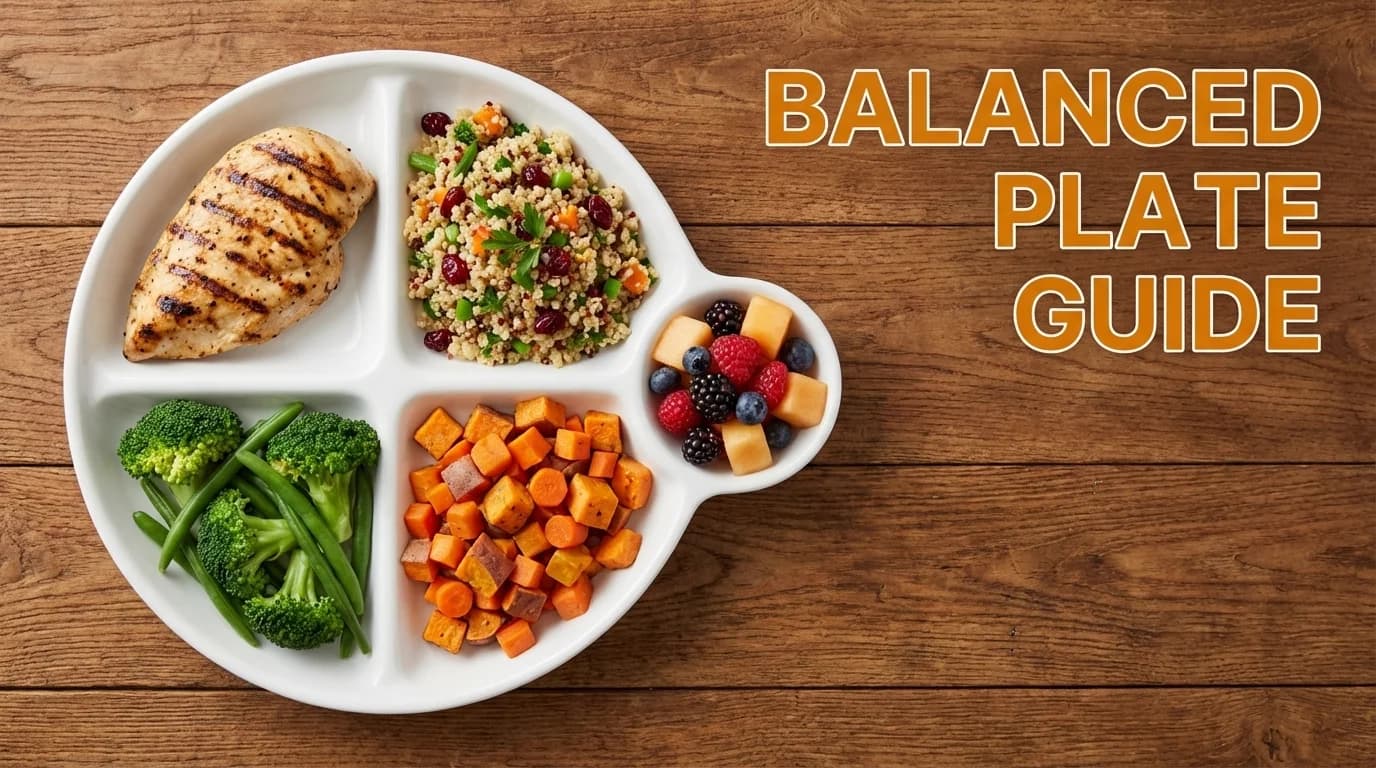
The Plate Method is the simplest way to build balanced meals without tracking every gram. The rule: fill half your plate with non-starchy vegetables, a quarter with lean protein, and a quarter with complex carbs. That ratio naturally puts you in a good nutritional range without obsessing over numbers.
Here's what it looks like across three meals:
- Breakfast — overnight oats (complex carb) with Greek yogurt stirred in (protein) and a handful of berries
- Lunch — big salad with mixed greens and chopped veg (vegetables), grilled chicken or chickpeas (protein), a scoop of quinoa on the side (carb)
- Dinner — chicken stir-fry with broccoli, bell peppers, and snap peas (vegetables), served over brown rice (carb)
No weighing, no calorie counting at the plate level. Just proportions. Once it becomes a habit, you'll do it automatically.
Ingredient stacking cuts your cooking time in half
The most common beginner mistake is cooking a completely new meal every night. That's exhausting. Ingredient stacking means cooking one versatile base ingredient and using it differently across several meals.
A practical example: roast a whole chicken on Sunday afternoon. That one cooking session funds three different meals:
- Sunday dinner — sliced chicken with roasted sweet potatoes and green beans
- Monday lunch — shredded chicken tossed into a salad with your favorite dressing
- Tuesday dinner — that same shredded chicken becomes quick tacos with black beans and salsa
Same protein, three completely different eating experiences. This approach works just as well with quinoa, roasted vegetables, hard-boiled eggs, and lentils.
A sample 7-day plan
Use this as a template, not a strict prescription. Swap proteins or carbs freely — chicken for tofu, quinoa for brown rice. If you want to confirm the swap still hits your goals, run it through the calorie and macro calculator.
| Day | Breakfast | Lunch | Dinner |
|---|---|---|---|
| Monday | Greek yogurt with berries and nuts | Leftover chicken and veggie stir-fry | Lentil soup with whole-wheat bread |
| Tuesday | Scrambled eggs with spinach and toast | Quinoa salad with chickpeas and veg | Salmon with roasted asparagus and quinoa |
| Wednesday | Overnight oats with chia seeds | Leftover lentil soup | Turkey meatballs with zucchini noodles |
| Thursday | Smoothie with protein powder and fruit | Leftover salmon on mixed greens | Black bean burgers on whole-wheat buns |
| Friday | Whole-wheat toast with avocado | Leftover turkey meatballs | Veggie pizza on whole-wheat pita |
| Saturday | Oatmeal with sliced banana | Mixed green salad with canned tuna | Flexible — eat out or use what's left |
| Sunday | Veggie omelet | Leftovers from the week | Roasted chicken with mixed vegetables |
The best meal plan is a flexible one. Having a plan gives you structure — giving yourself room to swap a meal or eat out once prevents you from feeling defeated and abandoning the whole thing.
How do I create a grocery list that saves time and money?

A meal plan is only as good as your execution at the store. The most common grocery mistake is writing items down as they come to mind — then spending 45 minutes backtracking across the store and throwing extras into the cart out of frustration.
The fix: organize your list by store section before you leave the house. You'll move through the store faster, miss fewer things, and spend less.
Organize by store section
- Produce — all fresh fruits and vegetables
- Proteins — meat, poultry, fish, eggs, tofu
- Pantry — grains, canned goods, spices, oils, shelf-stable items
- Dairy and alternatives — milk, yogurt, cheese, non-dairy options
- Frozen — frozen fruit, vegetables, extra proteins for backup
A reliable beginner grocery list
| Produce | Protein | Pantry and grains | Dairy and alternatives |
|---|---|---|---|
| Spinach or kale | Chicken breast or thighs | Brown rice or quinoa | Greek yogurt (plain) |
| Broccoli or cauliflower | Ground turkey or lean beef | Rolled oats | Milk or almond milk |
| Onions and garlic | Eggs | Canned black beans | Cottage cheese |
| Sweet potatoes | Canned tuna or salmon | Whole-wheat pasta or lentils | Cheddar or feta |
| Bell peppers | Tofu or chickpeas | Olive oil and vinegar | |
| Avocados | Almonds and chia seeds | ||
| Apples and bananas | Cumin, paprika, garlic powder |
Make your groceries go further
Stock a core set of pantry staples in bulk — oats, brown rice, quinoa, dried beans. They're cheap, last months, and form the base of dozens of meals. For produce, favor items with a longer shelf life: apples, onions, carrots, sweet potatoes. You'll waste less and save more.
When you have a well-stocked fridge and pantry, you'll always have something to cook. On nights when you're not sure what to make, the meal from fridge tool can suggest a meal from whatever you already have on hand.
According to World Bank data, a healthy diet costs an average of $4.46 per person per day globally — still out of reach for 2.6 billion people. Smart shopping and reduced food waste are the most practical levers for making healthy eating affordable. Read more about these food affordability findings on worldbank.org.
Read nutrition labels in 30 seconds
You don't need to decode the entire panel. Focus on two things: added sugars and serving size. Added sugars hide in "healthy" products like flavored yogurt, granola bars, and pasta sauce. On US labels, look for the "Includes Added Sugars" line under Total Sugars. In the ingredients list, anything ending in "-ose" (fructose, sucrose, dextrose) is a sugar, as are honey, maple syrup, and corn syrup.
Serving size is the other trap. A bag of chips that looks like one serving is often labeled as 2.5 servings. Check the number before assuming the calorie count applies to the whole package.
What common meal planning mistakes should I avoid?
Most people don't fail at meal planning because the concept is hard. They fail because of four specific, avoidable mistakes. Here's what to watch for.
Getting too ambitious too fast
Week one is not the time to try complicated recipes from food blogs. Complex, multi-step meals on a busy weeknight is a reliable path to ordering takeout instead.
Start with three or four recipes you already know you can make quickly. These become your anchors for the week. Once you feel comfortable, introduce one new recipe per week. That's a pace you can actually maintain.
Forgetting about snacks
Planning only breakfast, lunch, and dinner leaves a gap at 3 PM when hunger hits and willpower is lowest. Without a healthy option ready, you'll grab whatever's nearest — usually not what you planned.
Schedule one or two snacks per day the same way you plan meals, and put them on the grocery list. Greek yogurt, a piece of fruit with almonds, carrot sticks with hummus — easy, filling, and ready to grab. Spending 20 minutes on Sunday portioning out snacks for the week removes the decision entirely when you're tired and hungry.
Planning without scheduling prep time
A meal plan without a prep session is just a wish list. Block out 1–2 hours at the start of the week — Sunday afternoon works for most people — and treat it like any other appointment. That's when you wash and chop vegetables, cook grains, and portion out proteins. Weeknight cooking becomes fast when the hard parts are already done.
Building a plan with no flexibility
A rigid plan breaks at the first disruption. Work runs late. Someone invites you to dinner. You're just not in the mood for what you planned. If every deviation feels like failure, you'll stop entirely.
Build wiggle room in deliberately. Mark one or two nights per week as "leftover nights" or "flexible meals." Keep two or three five-minute emergency meals on hand — scrambled eggs on toast, canned lentil soup, a protein shake with fruit. That way, a schedule change doesn't wreck the whole week. If you want a plan that adjusts itself when things shift, Kitchendary's AI meal planner can regenerate your week in seconds around whatever's changed.
A week in the life: what meal planning actually looks like
It helps to see the full cycle once rather than just the theory. Here's how a typical week runs for someone starting out:
- Friday evening — spend 10 minutes sketching out next week's meals. Nothing elaborate: just pick dinner for each night and decide on two or three lunch staples.
- Saturday morning — write the grocery list organized by section. Shop once. Takes about 45 minutes.
- Sunday afternoon — 90-minute prep session. Cook a batch of grains, roast a tray of vegetables, prep proteins. Portion snacks.
- Monday through Friday — assembly, not cooking. Most dinners take 20 minutes because the components are already ready. Lunch is usually leftovers or a pre-made component meal.
- Saturday — a flexible meal or eat out. No guilt, just built into the plan.
That's roughly 2.5 hours of active work across the week to eat well for all 21 meals. The more you do it, the faster the planning and prep become.
FAQ
How much time does meal prep actually take as a beginner?
Plan for 1–2 hours once a week. Focus on 'component prepping' — cook grains, roast vegetables, grill proteins in batches — rather than making complete meals from scratch. Weeknight assembly then takes 15–20 minutes instead of 45.
What if I don't want to eat what I planned that day?
Keep 2–3 simple emergency meals on hand and give yourself permission to swap. A plan is a guide, not a contract. Flexibility built into the system is what keeps you consistent over weeks and months.
Is meal planning actually cheaper than not planning?
Yes, reliably. You buy exactly what you need, waste less produce, and order takeout less often. A grocery list tied to a specific plan is the single most effective tool for reducing food spending.
How do I stick to my plan when I eat out?
Look at the menu before you go so you're not making a decision under pressure. Ask for sauces on the side, choose grilled or baked options over fried, and don't skip the meal entirely — that usually leads to overeating later.
Can I eat snacks on a meal plan?
You should. Planning 1–2 snacks per day keeps hunger stable and prevents overeating at main meals. The key is having them ready in advance, not making a decision when you're already hungry.
How do I plan meals for a family with picky eaters?
Use build-your-own meals for at least a few nights — tacos, grain bowls, pizza — where everyone assembles their own plate from a set of components. Reduces conflict, keeps everyone fed, and still lets you control the ingredients.
My schedule changes constantly. How can I plan anything?
Instead of assigning specific meals to specific days, plan by theme: a stir-fry night, a soup night, a grain bowl night. You know what the week's meals will be, but you decide which one to cook based on how the day goes. Gives you structure without rigidity.
Do I need to count calories to meal plan?
No — the Plate Method gives you a practical visual check without tracking. That said, if you have a specific weight loss or muscle gain goal, knowing your rough daily calorie target helps you confirm your plan is actually set up for results.