You know meal planning is good for you. You have read about the benefits, seen the perfectly organized meal prep containers on social media, and maybe even downloaded a few apps promising to fix your kitchen routine. Yet here you are, standing in front of your open fridge at 6 PM on a Tuesday, wondering what on earth you are going to make for dinner. Again.
If this sounds familiar, you are not alone. Only about 37% of people consistently plan their meals before cooking, despite it being widely recognized as one of the best tools for better nutrition, lower grocery bills, and less stress. The gap between knowing meal planning works and actually doing it reveals a set of real, interconnected problems — not a lack of motivation.
This article breaks down exactly why meal planning is hard, and what you can do about each barrier. No vague advice about "building better habits." Specific, actionable fixes for the specific problems you are probably running into.

The core reasons meal planning feels overwhelming
Meal planning is not one problem. It is several problems stacked on top of each other, each making the others worse. At its core, the difficulty comes from four sources:
- Decision fatigue — you are making food choices at the worst possible moment (end of day, mental energy depleted)
- Time pressure — real life leaves you 30 minutes for dinner, not the 60 most recipes assume
- Grocery coordination — turning meal ideas into an accurate shopping list requires more mental math than people expect
- Household complexity — picky eaters, dietary restrictions, and unpredictable schedules multiply every decision
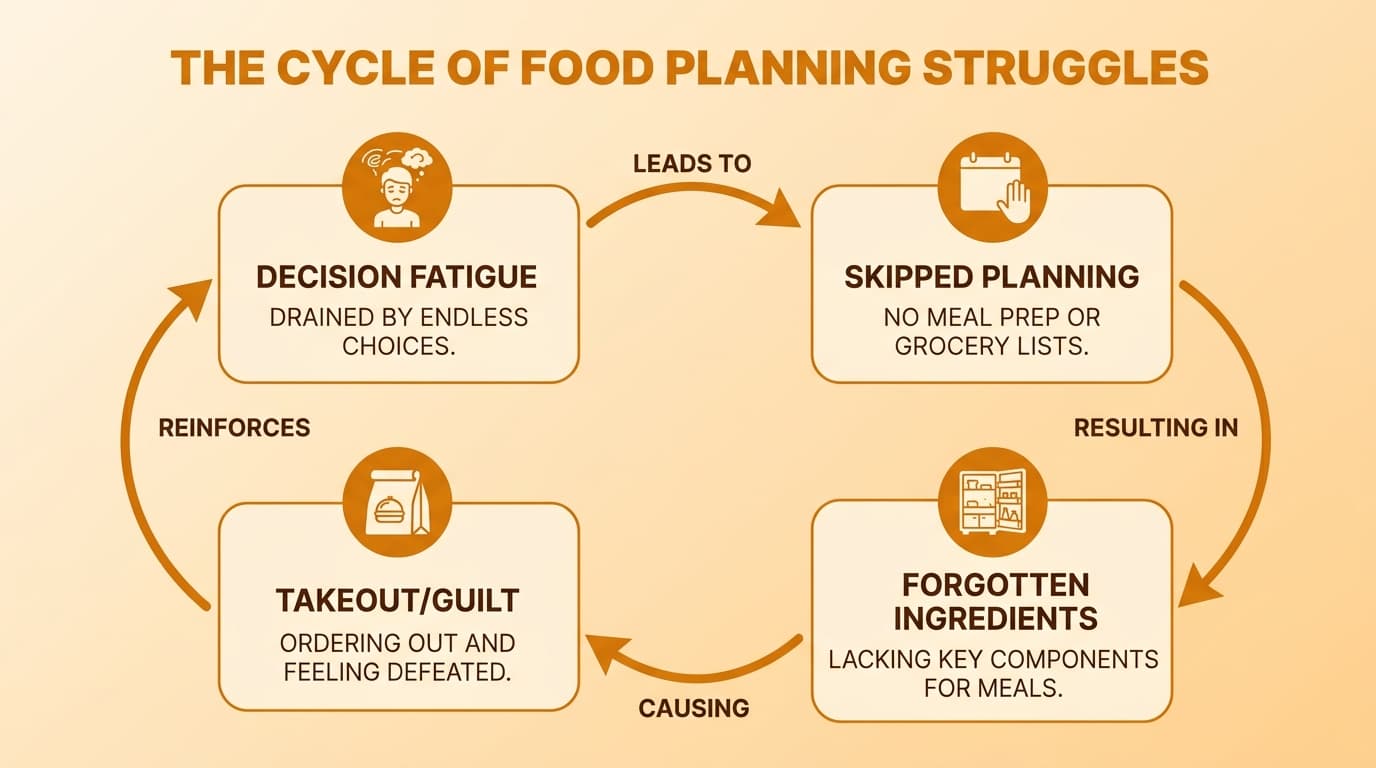
These problems compound. Decision fatigue makes grocery coordination harder. Household complexity makes time pressure worse. The result is a cycle: poor planning leads to takeout, takeout reinforces the idea that home cooking is too complicated, and the cycle repeats.
Decision fatigue: the hidden mental burden
Adults make approximately 35,000 decisions daily. Food choices — what to eat, when to cook it, what to buy, what to skip — consume a meaningful chunk of that budget. By the time evening arrives, your brain is already depleted from work decisions, logistics, and everything else. Meal planning at 7 PM is like trying to write a budget after running a marathon.
This is why you end up spending 40 minutes scrolling recipes and then ordering pizza anyway. It is not laziness. It is the paradox of choice: more options make the decision harder, not easier. Having 500 recipes available online makes the problem worse, not better.
The fix is removing decisions, not adding structure. Here is how the approaches compare:
| High-friction approach | Low-friction approach |
|---|---|
| Browse recipes every week from scratch | Rotate 15-20 proven meals your household likes |
| Plan meals after work when you are tired | Plan Sunday morning with coffee, before your day starts |
| Decide each night what to cook | Pick from a week's pool of 5-6 pre-selected meals |
| Use a different recipe source every time | Keep a saved recipe library you actually trust |
| Build grocery list from memory | Auto-generate list from selected meals |
The goal is to make the planning session itself take 20 minutes, not two hours. When you reduce the number of decisions required per session, you can actually finish.

Time management: the math does not add up
The average working professional has 30-45 minutes for weeknight dinner. Most recipes assume you have 60 minutes and full mental energy. That gap is where meal planning dies.
The time problem is not just cooking — it is everything around cooking:
- Unplanned grocery shopping: 1-2 hours, often more
- Recipe research: 30-90 minutes if you are starting from scratch
- Building a shopping list from multiple recipes: 20-40 minutes
- Mid-week store runs for forgotten ingredients: 30+ minutes per trip
The irony is that spending 20-30 minutes planning on Sunday saves 3+ hours scattered across the week. But when you are already stretched thin, investing that upfront time feels impossible. You keep skipping it and paying the tax every single night.
The weeknight rush in practice
Here is what a typical unplanned Tuesday evening looks like for a lot of people:
- 6:45 PM: Get home, realize nothing is defrosted
- 6:50 PM: Open fridge, find half a block of cheese, some wilting spinach, and a mysterious container from last week
- 6:55 PM: Start scrolling recipes, nothing feels achievable in 30 minutes
- 7:10 PM: Order food delivery — arrives in 40 minutes
- 7:50 PM: Eat dinner, feel mild guilt, tell yourself you will plan next week
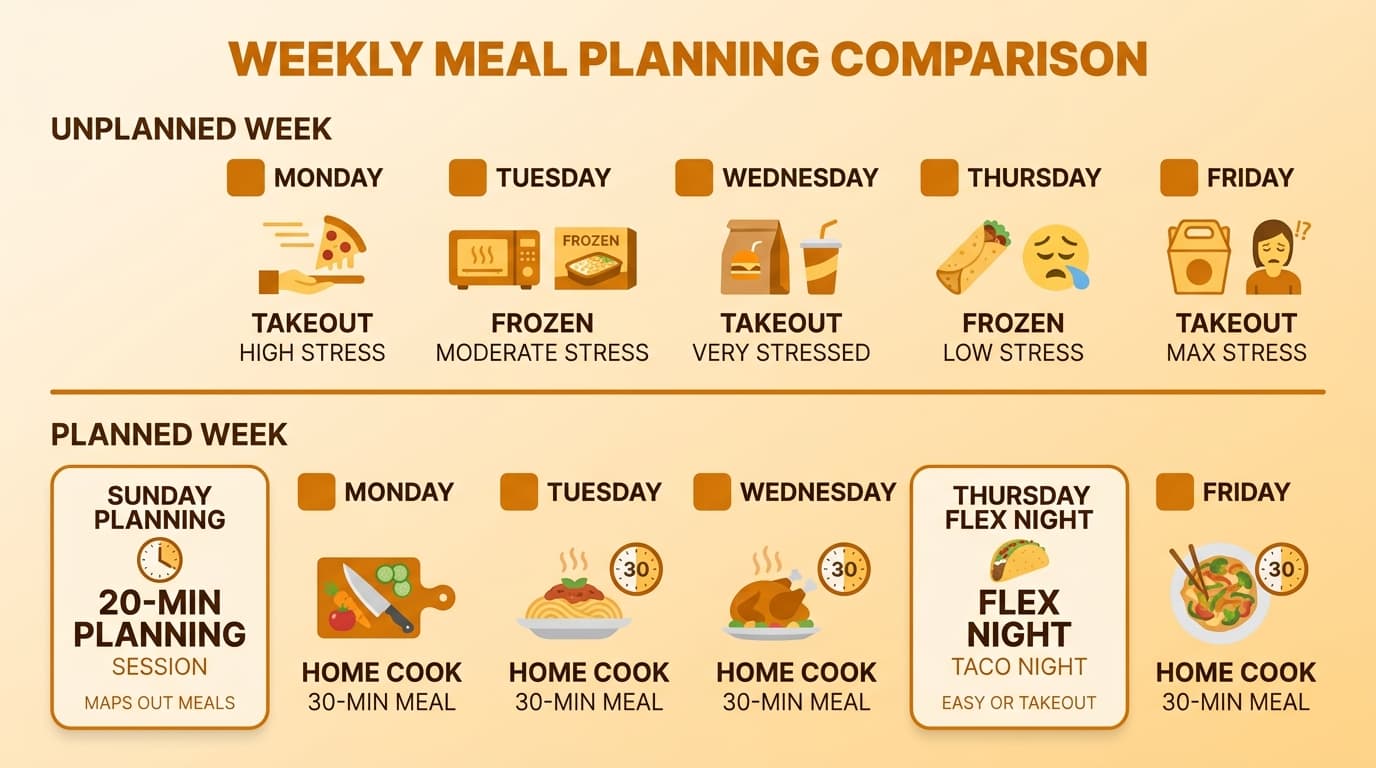
Compare that to a planned Tuesday with meals selected on Sunday: you walk in, pull out the ingredients you already bought, and have dinner on the table in 30 minutes. The difference is not willpower. It is whether the decision was already made.
Grocery shopping complexity
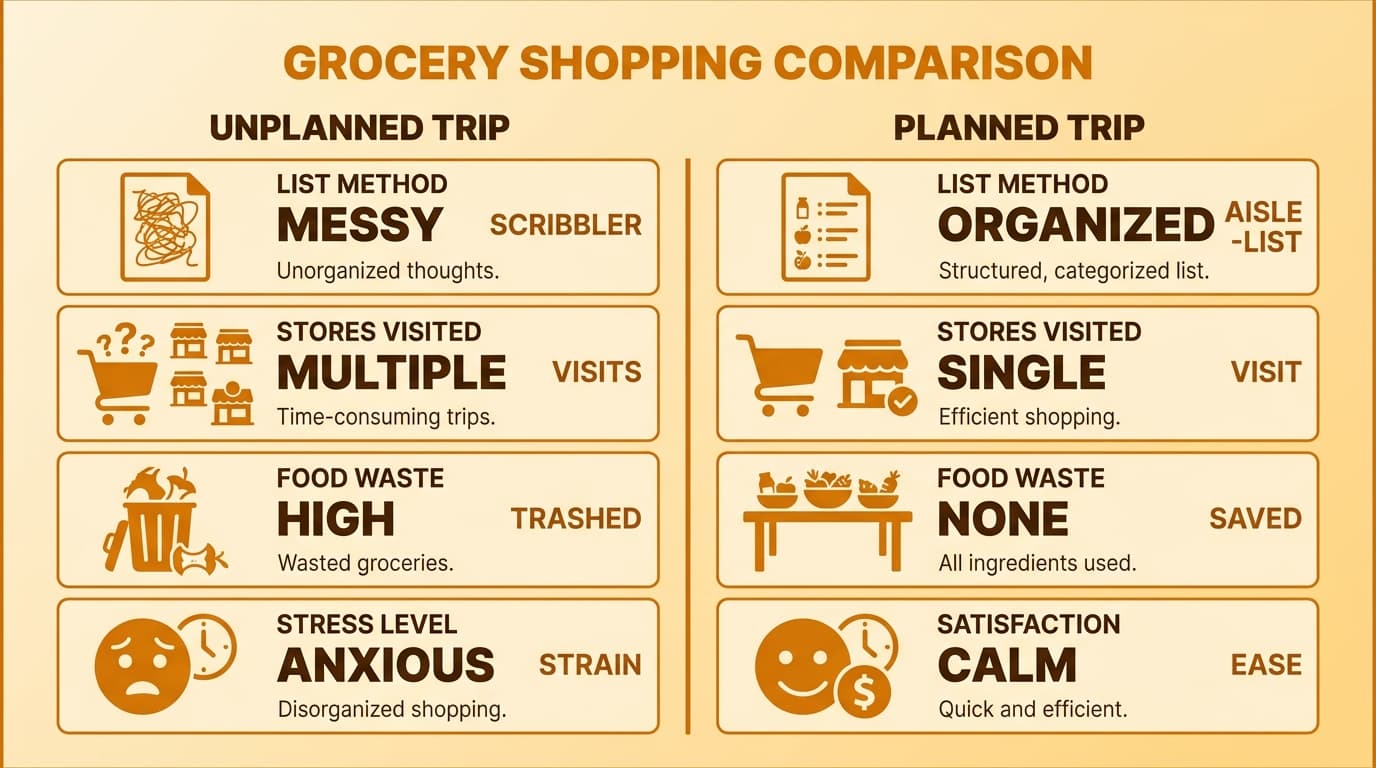
Building a grocery list sounds simple. In practice it requires you to simultaneously track multiple recipes, check what you already have, account for pantry staples, predict how much of each ingredient you need, and sequence perishables so nothing spoils before you use it. That is a lot of cognitive work.
Common grocery planning failures:
- Forgetting staples (olive oil, spices, stock) that recipes assume you have
- Buying the same ingredient for multiple recipes but not combining quantities
- Buying fresh produce for Friday's meal on Sunday — and watching it spoil by Wednesday
- Out-of-stock items forcing last-minute recipe pivots with no backup plan
- Bulk buying without a plan to use it before it goes bad
The solution is separating the planning from the shopping. When you plan meals first, then auto-generate a consolidated shopping list, most of these problems disappear. The list accounts for overlapping ingredients, checks common pantry needs, and organizes by store section. You stop buying a full bottle of tahini for one recipe you will never make again.
Family preferences and dietary restrictions
Planning meals for one person is manageable. Planning for a household with different preferences, allergies, and dietary needs is a different problem entirely.
A realistic household might include:
- One adult eating lower carb for health reasons
- A child who refuses vegetables and most proteins except chicken nuggets
- Another child with a tree nut allergy
- A partner who does not eat red meat
The math here is brutal. Each constraint eliminates recipes. The intersection of everyone's requirements can feel impossibly small. And when you do find something that works, it gets boring fast because the pool is so limited.
The practical workaround most experienced meal planners use is building meals around a flexible base rather than a fixed recipe. Grain bowls, tacos, stir-fries, and pasta dishes all work this way — you make the base, then people assemble their own version with different proteins, toppings, or sauces. It is not a perfect solution, but it cuts the negotiation work down significantly.
| Rigid recipe approach | Flexible base approach |
|---|---|
| One meal, take it or leave it | Shared base + personal customization |
| Separate meals for dietary needs | Swappable proteins/toppings at the table |
| Recipe fails if one ingredient is refused | Each person picks what works for them |
| Double cooking workload for restrictions | One prep session serves everyone |
Food waste and budget pressure
Americans waste approximately $1,500 worth of food per year from poor planning. That number stings because the waste is almost entirely predictable and preventable.
The pattern is consistent: you buy ingredients for ambitious recipes, life gets in the way, and you default to something simpler while the fresh produce slowly dies in your fridge. The specialty items — the kalamata olives, the fresh herbs, the $6 bunch of kale — go in the bin. And there is a specific kind of guilt attached to it that actually makes future planning feel worse, not better.
Three things reduce food waste without requiring a perfect planning system:
- Schedule perishables early in the week. If you buy leafy greens, plan to use them Monday or Tuesday. Root vegetables and cruciferous veg (broccoli, cauliflower, cabbage) can go later in the week.
- Plan meals that share ingredients. If one recipe uses half a can of coconut milk, plan a second recipe that uses the other half. Same for fresh herbs, specialty sauces, and open packages.
- Be honest about how many nights you will actually cook. Planning 7 dinners when you reliably cook 4 guarantees waste. Build in one or two flex nights upfront.
Skill gaps: when recipes assume too much
A lot of recipes are written by people who cook professionally. They use terms like "sweat the aromatics," "reduce by half," or "fold in gently" — and assume you know what these mean. If you did not grow up cooking or never formally learned, these instructions can make a recipe feel unapproachable even when the dish itself is straightforward.
This creates a confidence problem. You try a recipe, something goes wrong because an instruction was unclear, and you feel like cooking is not for you. The real issue is the gap between recipe assumptions and your actual skill level — not your ability to learn.
The fix is matching recipe complexity to where you actually are right now, not where you aspire to be. A few practical shifts:
- Filter recipes by prep time, not just ingredients — short prep times usually mean simpler techniques
- Start with sheet pan meals and one-pot dishes — they are forgiving and hard to mess up
- Learn 5-6 basic techniques well (roasting, sauteing, boiling, building a sauce) and you can make most simple recipes confidently
- Use a meal planner that filters by difficulty so you are not accidentally choosing restaurant-level recipes for a Tuesday night
The solution: reduce the decisions, not just the work
Most advice about meal planning focuses on adding more structure — more templates, more prep, more organization. That helps, but the root problem is cognitive load, not lack of organization.
The real fix is removing as many decisions from the process as possible:
- Use AI-generated meal plans that match your preferences so you are curating, not creating
- Auto-generate grocery lists from your selected meals so you are not doing mental math at the store
- Build a saved recipe library so you are not starting from scratch every week
- Use a flexible weekly pool instead of day-specific assignments so schedule changes do not blow up your plan
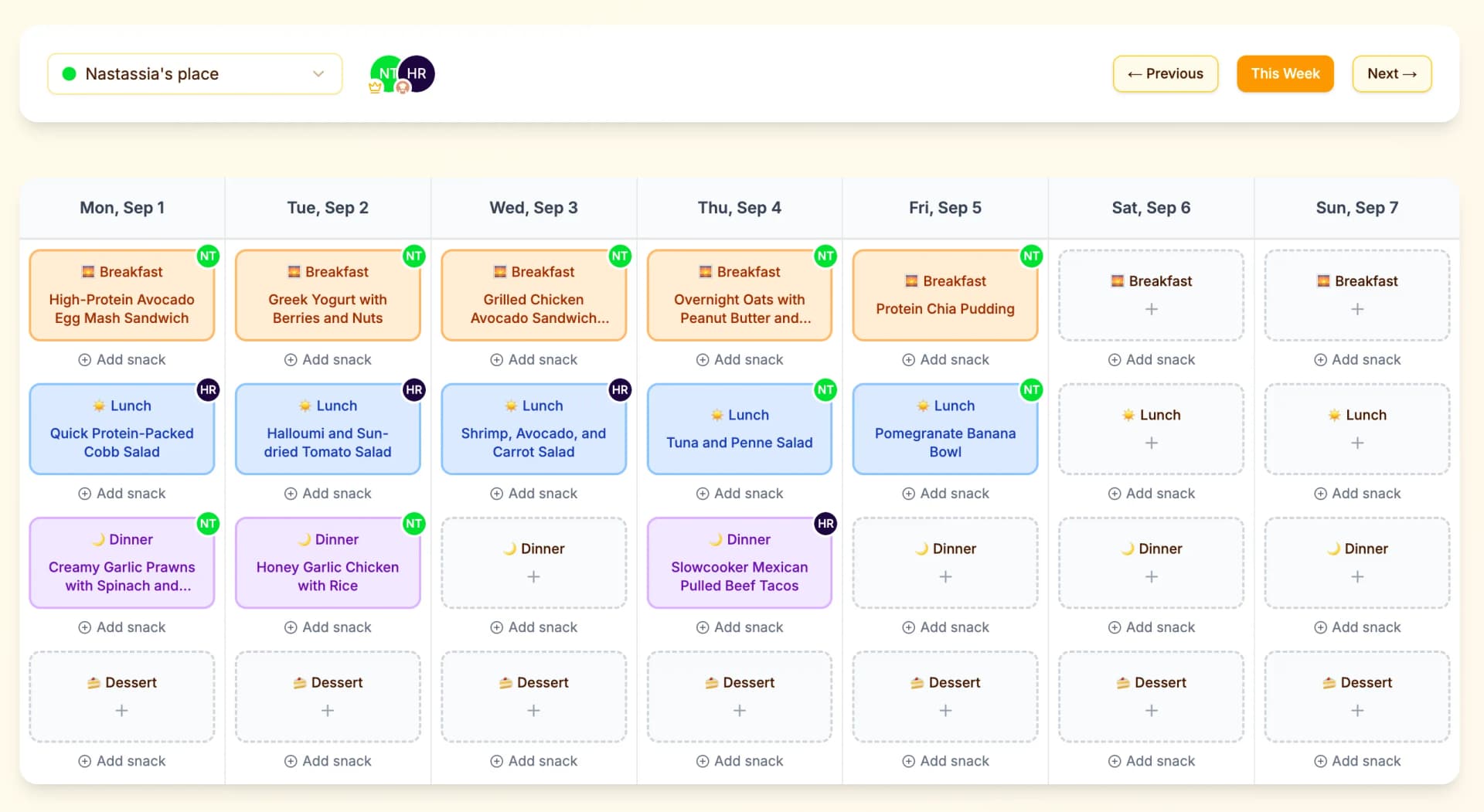
Kitchendary generates a full 7-day meal plan in under 60 seconds based on your preferences, dietary needs, and schedule. The grocery list is built automatically, consolidated across all recipes, and organized by store section. It does not eliminate the effort of cooking — but it does eliminate most of the effort of planning, which is where most people get stuck.
Building sustainable meal planning habits
The goal is a system that works when your week gets chaotic, not just when you have ideal conditions. A few principles that hold up in practice:
- Start with 3-4 planned dinners, not 21 meals. You can expand from there. Trying to plan everything immediately is how you burn out in week two.
- Pick one planning day and make it non-negotiable. Sunday morning with coffee is the most common. The specific day matters less than the consistency.
- Build a rotation of 15-20 reliable meals. Not exciting meals — reliable ones. You can add new recipes occasionally, but having a proven roster prevents the blank-page problem every week.
- Plan a pool, not a schedule. Instead of "Monday is pasta, Tuesday is chicken," pick 5-6 meals for the week and decide each day which one fits. This survives schedule changes.
- Involve everyone once a week, not every night. A 10-minute Sunday conversation where family members pick one or two meals beats nightly negotiation.
None of this requires perfection. A week where you cooked 4 out of 5 planned meals is a good week. Treat planning avoidance as a signal to simplify the system, not a character flaw.
Conclusion
Meal planning is hard for real, structural reasons — not because you lack discipline. Decision fatigue, time pressure, grocery coordination complexity, and household logistics all compound each other. Knowing which problem is actually blocking you is the first step toward fixing it.
The path forward is not a perfect system. It is a simple-enough system you will actually use. Start small, reduce the number of decisions required each week, build a meal rotation you trust, and use tools that handle the repetitive parts automatically. The 6 PM fridge-stare problem is solvable. It just takes addressing the right causes.
FAQ
Why is meal planning so hard for most people?
Meal planning is hard because it combines decision fatigue, time pressure, grocery coordination, and family preferences all at once. Adults make roughly 35,000 decisions per day, and food choices consume a significant portion of that mental energy — leaving little capacity for thoughtful planning by the end of the day.
How do I stop feeling overwhelmed when meal planning?
Start small. Instead of planning all 21 meals a week, begin with just 3-4 dinners. Pick one consistent day to plan (Sunday mornings work well), build a rotation of 15-20 reliable meals your family enjoys, and use a tool that generates shopping lists automatically so you're not starting from scratch each time.
How much time does meal planning actually take each week?
With the right system, effective meal planning takes 20-30 minutes per week. The time sink is usually recipe research and building shopping lists manually. Meal planning apps that curate recipes and auto-generate grocery lists cut that time significantly.
How do I meal plan when my family has different dietary needs?
Focus on flexible base meals that can be adapted -- like grain bowls, tacos, or stir-fries -- where each person can adjust their toppings or protein. Building a shortlist of crowd-pleasing recipes that meet everyone's requirements reduces the negotiation work every week.
How can I reduce food waste when meal planning?
Plan meals that share ingredients, schedule perishables earlier in the week, and be realistic about how many nights you'll actually cook. Buying produce mid-week for the second half of the week is better than buying everything Sunday and watching it wilt by Thursday.
Is meal planning worth it if my schedule is unpredictable?
Yes -- but you need a flexible plan, not a rigid one. Instead of locking in specific meals to specific days, plan a pool of 5-6 meals for the week and decide each day which one fits. This gives you structure without setting yourself up for failure when plans change.