Healthy meal prep for work starts with one simple session: pick 2–3 recipes, build a grocery list, and block two hours on the weekend. Cook one protein, one carbohydrate, and a few vegetables you can mix and match throughout the week. That's the whole system. Everything else is just optimization.
Most people overcomplicate this. They try to plan seven separate meals, discover three new recipes, and buy ingredients they'll never use again. That's not meal prep — that's a recipe for a half-eaten fridge and an abandoned habit by week two.
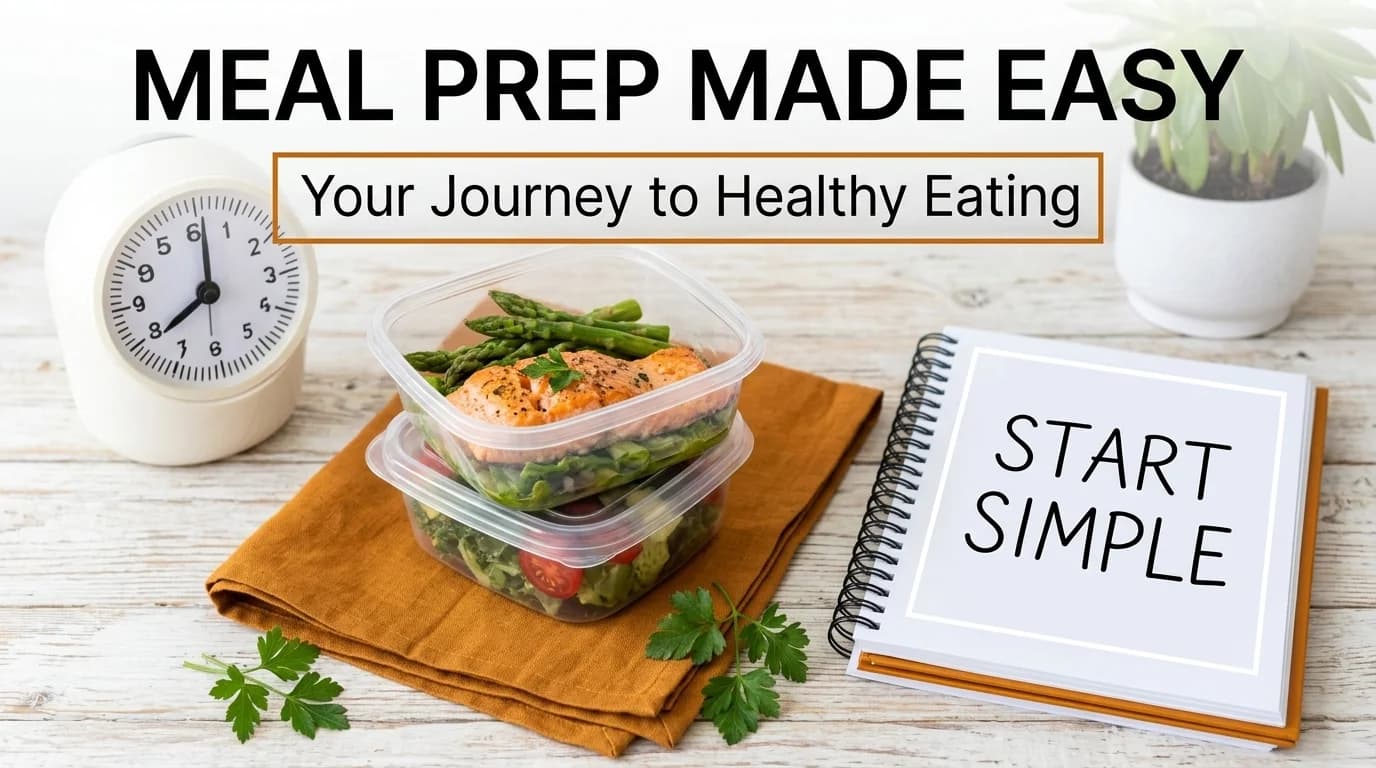
A sustainable meal prep routine pays off beyond the kitchen. It breaks the takeout cycle, kills the 3 p.m. vending machine temptation, and gives your workday a baseline of decent nutrition that actually shows up in your focus and energy. Two hours on Sunday saves you from making bad food decisions five times next week.
Before planning your first set of recipes, it helps to know what your body actually needs. A calorie and macro calculator gives you a solid baseline so your meals have a purpose, not just good intentions.
Why Meal Prep Matters for Busy Professionals
The midday food problem is real. You're already juggling back-to-back meetings, a growing task list, and declining willpower — and now you have to decide what to eat. Expensive takeout or a sad vending machine snack both feel like the path of least resistance, and they quietly chip away at your afternoon performance.
It reclaims your lunch break
When you have a meal ready, your break is an actual break. You're not solving a logistical problem or waiting in a line. You eat, you step away from the screen, and you come back with something left in the tank.
Most workers don't get that. 88% of employees say they feel refreshed after a real break, but 70% of workers eat at their desks at least once a week. Among Gen Z, only 10% say they never eat at their desk — compared to 48% of baby boomers who make stepping away a consistent habit.
The real cost of convenience food
The financial hit from daily takeout is easy to calculate. The hidden cost is harder to see. Convenience food typically means excess sodium, processed fats, and refined carbs — a combination that reliably produces an early-afternoon energy crash. You're not just spending money, you're spending focus.
Cooking your own meals gives you control over ingredients and portions. That control isn't just about saving money — it's a direct input on your cognitive performance every afternoon of the week.
A well-balanced prepped lunch — lean protein, complex carbs, and some fat — provides steady energy through demanding afternoons rather than a spike and a drop.
Why a system beats willpower
Healthy meal prep for work works because it removes friction, not because it requires more discipline. When the decision is already made and the food is already cooked, you don't need willpower at 12:30 p.m. Here's what a simple system handles for you:
- Decision fatigue — you make one choice about lunches for the week, not five separate ones under pressure.
- Nutrition consistency — your meals already align with your health goals before the week starts.
- Budget control — skipping daily food purchases adds up faster than most people expect.
Tools like Kitchendary can automate the entire planning step, removing the guesswork and turning healthy eating into the path of least resistance rather than the effortful one.
How to Plan Your First Week of Work Meals
Your first week doesn't need to be ambitious. It needs to be doable. Breaking the process into four parts makes it manageable without becoming a project.
Set a specific goal
Know why you're doing this before you look at a single recipe. Are you trying to cut the takeout habit? Beat the afternoon energy crash? Hit a macro target for a fitness goal? Your reason shapes every choice downstream. If you're fighting afternoon fatigue, you build meals around lean protein and complex carbs. If you're cutting costs, you build around cheap staples like lentils and rice. A clear goal turns meal prep from a chore into a decision framework.
Choose your prep style
There are two approaches to meal prep, and they suit different people and schedules.
| Approach | How it works | Best for | Trade-off |
|---|---|---|---|
| Batch cooking | Cook complete meals in large quantities, then portion them out | People who want zero decisions during the week | Less variety — Monday and Thursday are the same meal |
| Ingredient prep | Cook separate components (protein, grain, veg) and assemble daily | People who get bored easily or have changing schedules | Requires slightly more thought at lunchtime |
For your first week, batch cooking is the simpler path. It eliminates mid-week decisions while you're still building the habit. Once the routine feels automatic, you can switch to ingredient prep for more flexibility.
Pick beginner-friendly recipes
Here's where most first-timers go wrong: they try to cook five complicated new recipes at once. Don't. Start with meals you already know and like, and stick with recipes that have fewer than 10 ingredients. One solid strategy is to pick a single core protein and build the whole week around it. A big batch of shredded chicken can become a grain bowl on Monday, a salad on Tuesday, and a wrap on Wednesday. Different meal, same prep session.
The goal for your first week is consistency, not culinary range. Success is just having a healthy, ready-to-eat lunch every single workday.
To remove the planning burden entirely, use a tool like Kitchendary to generate a full week's meal plan tailored to your goals. Answer a few questions and get a complete plan in under 60 seconds.
Build a smart grocery list
Once you have your recipes, check your kitchen first. You'll often have more on hand than you think. Then organize your list by store section — produce, protein, dairy, pantry — so you move through the store without backtracking. A grocery list generator can auto-build this from your meal plan and save you the step entirely.
Sample 5-day healthy work meal plan
This beginner-friendly plan covers balanced macros, simple preparation, and meals that travel well in a lunch bag.
| Day | Breakfast (Prep-Ahead) | Lunch (Prep-Ahead) | Snack (Easy Grab) |
|---|---|---|---|
| Monday | Overnight Oats with Berries & Chia | Greek Chicken & Quinoa Bowl | Apple with Almond Butter |
| Tuesday | Overnight Oats with Berries & Chia | Tex-Mex Chicken Salad | Greek Yogurt |
| Wednesday | Egg Muffins with Spinach & Feta | Lentil Soup with Whole-Grain Bread | Handful of Almonds |
| Thursday | Egg Muffins with Spinach & Feta | Chicken & Hummus Wrap | Baby Carrots & Hummus |
| Friday | Smoothie Pack (pre-portioned fruit/veg) | Large Kale Salad with Chickpeas & Vinaigrette | Hard-Boiled Egg |
What a Real Meal Prep Monday Morning Looks Like
Abstract advice is easy to ignore. Here's what this actually looks like in practice for someone who works a standard office schedule.
Sunday, 4:00 p.m. — You spend 15 minutes checking the fridge and building a grocery list. You already have quinoa, canned chickpeas, and a few eggs. You add chicken thighs, kale, sweet potatoes, oats, and almond butter to the list.
Sunday, 5:00 p.m. — You get home from the grocery store. The chicken goes in the oven with olive oil and garlic. Quinoa goes on the stovetop. While both cook, you prep overnight oats in two mason jars and chop a full tray of sweet potatoes for roasting. Forty minutes later, the kitchen smells good and you've barely been at it.
Sunday, 6:15 p.m. — Everything cools on the counter while you watch something on TV. You portion the chicken, quinoa, and sweet potatoes into containers. The overnight oats go in the fridge. Five containers lined up for the week, total active time: about 90 minutes.
Monday, 7:45 a.m. — You grab an overnight oats jar and a lunch container on your way out the door. No deciding. No scrambling. The chicken bowl is sitting in the work fridge by 8:15, and by noon you're eating a meal you actually made, at a desk you voluntarily stepped away from.
That's it. No dramatic transformation — just a quieter, more functional workday.
The Best Foods to Prep Ahead for Work Lunches
Good meal prep isn't about complex recipes. It's about choosing ingredients that hold up in the fridge for a few days without turning into something sad. Here's what actually works in each food group.
Lean proteins that reheat well
Protein keeps you full and focused through long afternoons. The key is cooking it in a way that doesn't dry out by day three.
- Chicken breast or thighs — poach, slow-cook, or roast to lock in moisture. Shredded chicken is the most versatile option in any prep session.
- Lean ground meats (turkey, beef) — cook a big batch with simple seasoning and use it in bowls, wraps, or stuffed peppers.
- Plant-based proteins (chickpeas, lentils, tofu) — chickpeas and lentils work cold, no reheating required. Bake or pan-fry tofu until firm so it doesn't get soggy.
- Hard-boiled eggs — boil a dozen at the start of the week. Fast to prep, easy to grab, good for salads or a standalone snack.
If you're tracking macros, a recipe nutrition calculator gives you the exact numbers to confirm your meals line up with your goals.
Complex carbohydrates that don't turn to mush
Complex carbs provide slow-burning energy — the kind that doesn't spike and crash. You want grains and starches that hold their texture over several days.
- Quinoa — holds texture well, works hot or cold, and has more protein than most grains.
- Brown rice and farro — hearty, filling, and reliable through Friday.
- Sweet potatoes — roasted cubes or whole-baked, both reheat well and add a natural sweetness to bowls.
- Rolled oats — the go-to for overnight oats or baked oatmeal cups, prepped the night before and grabbed on the way out.
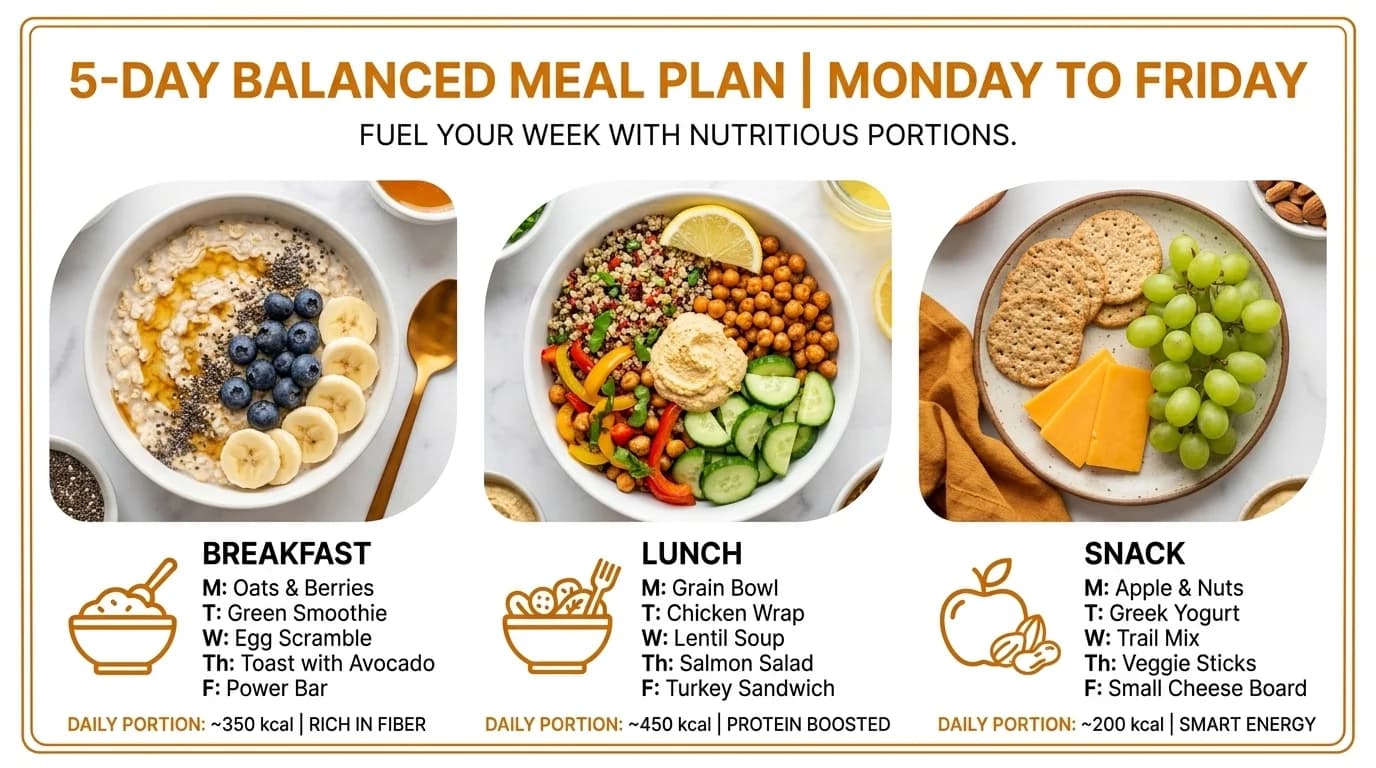
Here's a quick look at how these staples come together in a typical week.
Healthy fats — add them right before you eat
Fats are important for brain function and satiety, but they're also the ingredient most likely to wreck the texture of a prepped meal if you mix them in too early. Keep them separate and add them at lunchtime.
Fats are the finishing touch. Pack them separately and add them right before eating — this preserves their texture and keeps everything else from getting greasy.
- Avocado — bring a whole one to work and slice it at the table. Sliced avocado doesn't survive a day in the fridge.
- Nuts and seeds — almonds, walnuts, and chia seeds are shelf-stable and easy to add to anything.
- Dressings and oils — make a simple vinaigrette on Sunday and store it in a small, leak-proof container for the week.
Vegetables that actually survive the week
Not all vegetables hold up for five days. Spinach wilts by Tuesday. Soft greens turn slimy. Stick with the sturdy ones.
- Cruciferous vegetables — broccoli, cauliflower, and Brussels sprouts roast well and maintain their texture through the week.
- Root vegetables — carrots, beets, and parsnips are firm and versatile raw or roasted.
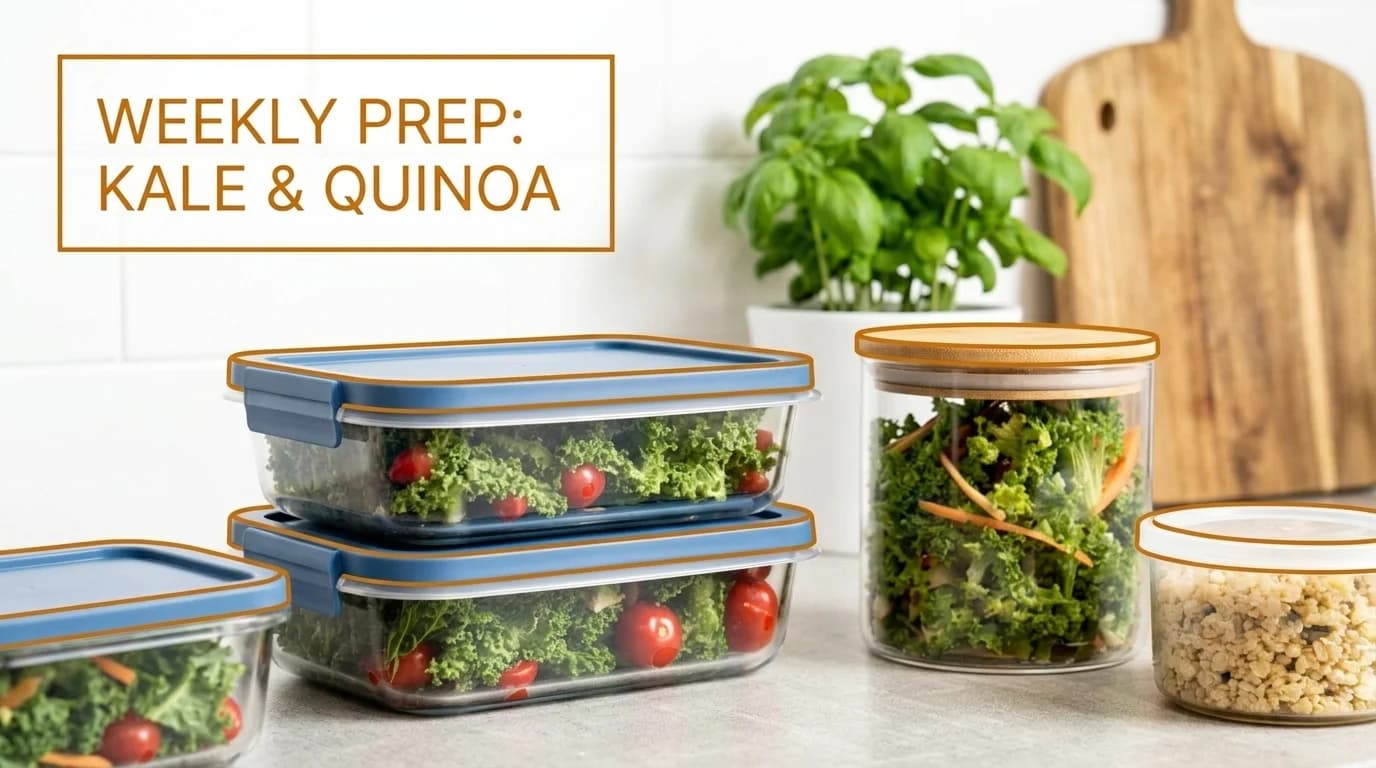
- Kale and shredded cabbage — use these as salad bases instead of spinach. They won't wilt overnight and actually improve slightly as they marinate in dressing.
- Peppers and red onion — stay crisp, add color, and work in almost any combination.
Meal prep food durability guide
| Ingredient | Best for (days) | Reheating quality | Pro tip |
|---|---|---|---|
| Roasted root veggies | 5+ | Excellent | Reheat in a toaster oven or air fryer to restore crispiness. |
| Quinoa/Farro | 5 | Very good | Fluff with a fork before reheating. |
| Shredded chicken | 4–5 | Excellent | Store with a little broth or sauce to keep it moist. |
| Lentils/Chickpeas | 5 | Good (can be eaten cold) | Absorb dressing over time — they get more flavorful, not worse. |
| Hard-boiled eggs | 5 | N/A (eaten cold) | Store unpeeled for maximum freshness. |
| Kale/Cabbage salads | 4 | N/A (eaten cold) | Keep dressing separate until just before serving. |
| Sautéed spinach | 1–2 | Fair | Best eaten early in the week — it releases water fast. |
| Sliced avocado | <1 | Poor | Pack a whole avocado and slice it fresh at lunchtime. |
How to Master Batch Cooking and Food Storage
A solid plan is one thing. Turning it into a fridge full of meals on Sunday is where the habit actually takes shape. The prepared meals market has reached USD 178.83 billion — you can read more about the prepared meals market — which says something about how many people have already figured out that cooking ahead of time is worth it.
A productive two-hour weekend workflow
The goal is to get the most done in the least amount of time. Don't just cook things in sequence — use your oven and stovetop simultaneously so everything finishes around the same time.
- First 30 minutes — get grains simmering and sheet-pan items (chicken, sweet potatoes) in a preheated oven. Set a timer and walk away.
- Next 60 minutes — while things cook, wash and chop raw vegetables, boil eggs, blend a dressing. Use the downtime, don't stand at the stove.
- Final 30 minutes — let everything cool to room temperature, then portion into containers. Label if you have more than one person's meals in the fridge.
How to beat flavor fatigue
The number one reason people quit meal prepping after two weeks is boredom. Eating the same meal five days in a row is fine once, tolerable twice, and a slow form of torture by week three. The fix is to prep components, not finished meals.
One batch of shredded chicken covers an entire week of variety:
- Monday — a Greek bowl with quinoa, cucumber, cherry tomatoes, and lemon-herb vinaigrette.
- Wednesday — a Tex-Mex salad over kale with black beans, corn, and cilantro-lime dressing.
- Friday — a wrap with whole-wheat tortilla, hummus, and fresh spinach.
Prep the components, not always the finished meal. That flexibility is what makes the habit actually stick.
The basics of food storage
Invest in quality, airtight containers. Glass is worth it — it doesn't stain or hold smells, works in the microwave, and lasts for years. Always let hot food cool to room temperature before sealing and refrigerating. Trapping steam inside the container accelerates spoilage and makes everything wet.
For salads, layer strategically: dressing on the bottom, hard vegetables next, protein and grains above that, leafy greens on top. The greens stay dry until you're ready to eat. If you find yourself with extra ingredients at the end of the week, a what-can-I-make-from-my-fridge tool can help you avoid waste.
How AI Can Simplify Your Meal Prep
Even with good intentions, the planning side of healthy eating can feel like a second job. The administrative grind — deciding what to make, checking macros, writing grocery lists — is usually what burns people out, not the cooking itself.
What AI actually does differently
Manually ensuring every day's meals hit a specific calorie and macro target takes real effort. An AI meal planner handles that math in seconds, producing a plan calibrated to your goals and preferences. It also removes decision fatigue at the planning stage — not just during the week, but before the week starts.
That's a meaningful difference. Most people fail at meal prep because the setup feels like too much work before they've cooked a single thing. AI tools remove that barrier entirely.
How Kitchendary works
Kitchendary is built specifically to cut meal planning time to under 60 seconds. Here's how the process actually works:
- Answer a quick profile — health goals, dietary restrictions, food preferences, how many people you're cooking for.
- The AI generates a complete weekly meal plan instantly, calibrated to your goals.
- A categorized grocery list is auto-built from every ingredient across all meals — organized by store section so you're not wandering the aisles.
- Swap any meal with one click. The replacement automatically fits your nutritional targets.
- Track your macros automatically as you log meals — no manual data entry.
This removes the two biggest friction points: deciding what to eat and tracking whether it's actually working. Both happen automatically, so you spend your time cooking, not planning.
The global meal delivery market is on track to hit US$455.55 billion, which you can explore in global meal delivery trends — and it reflects a clear shift toward convenience in how people eat. A tool like Kitchendary fits into that trend, but with one key difference: it gives you more control over what you eat, not less, by making the healthy option the easy one. You can also explore how to build a sustainable healthy meal planning habit if you want a broader look at the system beyond meal prep.
FAQ
How long does prepped food last in the fridge?
Most cooked meals last 3 to 5 days in airtight containers. Heartier ingredients like roasted vegetables, grains, and beans stay good longer than delicate items like fish or soft greens.
Is it possible to meal prep on a tight budget?
Yes — meal prepping is one of the most effective ways to control grocery spending. Build your weekly menu around inexpensive staples like oats, rice, lentils, and beans, and buy seasonal produce to stretch your budget further.
How do I keep my prepped meals from getting boring?
Prep versatile components instead of identical meals. Cook a batch of chicken, then use different sauces, spices, and toppings to build a Greek bowl one day and a Tex-Mex salad the next. Same protein, completely different experience.
What are the best containers for meal prep?
Airtight glass containers work best — they're microwave-safe, don't stain or hold odors, and last for years. For salads, layer ingredients with dressing at the bottom and greens on top to prevent sogginess.
How much time should I set aside for meal prepping?
A 2-hour block on Sunday is usually enough for a beginner to prep five days of lunches. Once you build a rhythm, most people get this down to 90 minutes or less.
Can I freeze my prepped meals?
Yes — soups, stews, chilis, and grain bowls all freeze well. This lets you extend meals past the 5-day window and build a ready-to-go stash for especially chaotic weeks.
What is the best protein to cook in bulk for work lunches?
Shredded chicken breast is probably the most flexible option. You can cook a large batch in a slow cooker or Instant Pot with minimal effort, then use it in bowls, wraps, salads, or soups throughout the week. Ground turkey and hard-boiled eggs are close runners-up.
How do I stop my salads from getting soggy by Wednesday?
Layer your containers strategically: dressing on the bottom, then hard vegetables like cucumbers and carrots, then grains or protein, with leafy greens on top. The greens don't touch the dressing until you flip or shake the container right before eating. Kale and shredded cabbage hold up significantly better than spinach or mixed greens.
Is it safe to meal prep for 5 days?
Yes, 5-day meal prep is safe as long as food is cooled quickly, stored in airtight containers, and kept at or below 40°F (4°C). Most cooked proteins, grains, and roasted vegetables hold for 3 to 5 days. For days 4 and 5, favor sturdier dishes like chili, curries, and grain bowls, or freeze two portions on prep day and thaw them mid-week. Reheat to 165°F (74°C) and never leave prepped food at room temperature for more than 2 hours.